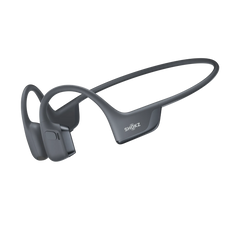
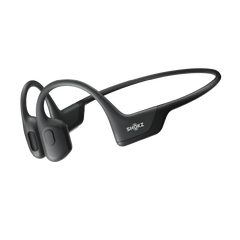

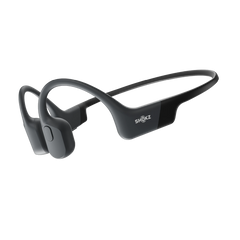
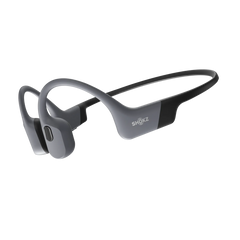


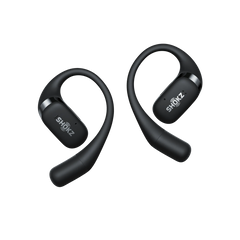
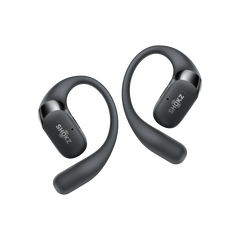


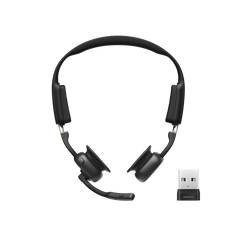
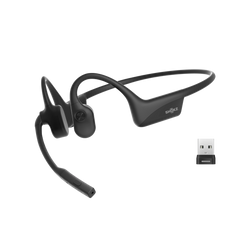
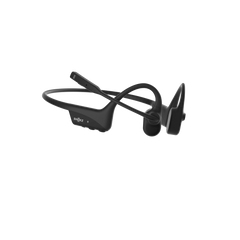


Leaving the ear canal open sounds simple in theory. In practice, it's one of the harder problems in headphone engineering: how do you deliver rich, clear sound through the air (or through bone) without it leaking to everyone around you, and how do you keep something secured to the outside of the ear comfortable for hours at a time? We've spent over a decade working through exactly that problem. Here's what's actually going on inside a pair of Shokz headphones.
The Core Challenge: Comfort Without Compromising Sound
Sealed headphones solve sound leakage and bass response by simply blocking the ear canal — problem avoided rather than solved. Open-ear headphones don't have that shortcut. Every gain in comfort or awareness has to be earned back somewhere else: in driver design, in materials, in the algorithms deciding how sound behaves in real time. That trade-off is the starting point for everything we build, and it splits into two engineering problems we tackle separately: getting the sound right, and getting the fit right.
Engineering the Sound

Open-Ear Sound Architecture, Powered by OpenSound
Shokz OpenSound marks our most advanced leap in open-ear audio, setting our highest benchmark for sound quality and audio innovation. It's built on our Open-Ear Audio Technology, which is engineered specifically to minimise sound leakage and enhance acoustic performance, delivering rich, clear sound from earbuds that sit outside the ear canal rather than sealed inside it. Because the driver isn't relying on a seal against your ear to do the work, everything about the sound path — size, structure, materials — has to be optimised specifically for an open design rather than adapted from a sealed one.
DirectPitch™: Directional Sound Without Blocking Your Ear
For our open-ear earbuds, we use DirectPitch™ technology to transmit sound to your ears without obstructing them — the same open-ear principle behind our bone conduction range, applied through an air-conduction driver instead. It's what lets you stay aware of your surroundings while still enjoying a proper listening experience, rather than choosing between the two.
Bone Conduction: DualPitch™ for Balanced Bass
For our bone conduction range, the sound engineering problem looks different, because there's no air-based driver involved at all — sound is converted into vibrations that travel through the cheekbone directly to the cochlea, bypassing the eardrum entirely. After 20 years of research into bone conduction acoustics, we developed DualPitch™ to solve the bass problem this creates: it pairs a bone conduction driver tuned for mid-to-high frequencies with a separate air conduction driver handling low-end texture, so you're not stuck with the thin, tinny sound early bone conduction headphones were known for. Our TurboPitch™ system takes this further, integrating a "CoreCushion" into the low-frequency vibration system for an even richer, more powerful bass response.
Engineering the Fit

Materials That Disappear on Your Skin
Sound is only half the engineering problem — the other half is what happens against your skin for hours at a stretch. To solve the discomfort of wearing earbuds for long periods, our engineers spent years developing Shokz Ultra-Soft Silicone™ specifically for use inside our earbuds — now in its second generation. It has been tested and rated at 16±3 on the Shore 00 hardness scale — not far off the softness of a marshmallow — making it significantly gentler against skin than harder materials used elsewhere.
PremiumPitch™: Comfort for Bone Conduction
Bone conduction brings its own comfort challenge: direct vibration against the skull is a common concern, since bone conduction headphones deliver sound by vibrating the temporal bone. We address this with PremiumPitch™, a technology that came out of extensive testing to find the transducer angle that best minimises this effect. The result is a carefully calibrated 30-degree angle against your cheekbone, which significantly reduces the numbness and buzzing sensation that excessive vibration can otherwise cause — one of the most common complaints about earlier bone conduction designs.
Built to Survive Sweat, Rain and Repetition
A lot of open-ear listening happens mid-workout, so durability has to be engineered in from the start. The waterproof rating across our current headphone range meets or exceeds level 4, covering sweat, rain and everyday exposure, while dedicated products like OpenSwim Pro go further with an IP68 rating for full submersion. On the fit side, OpenRun Pro 2 uses a unibody frame to prevent slipping, with built-in titanium memory wire that shifts the body's centre of gravity forward for improved overall balance and stability. Across our sports range, physical multifunction buttons are also designed to prevent accidental touches even with wet or sweaty hands mid-workout.
Why the Engineering Matters More Than the Spec Sheet
None of this is decoration. Every piece — the driver architecture, the directional sound, the silicone, the titanium wire, the waterproofing — is a direct answer to a specific complaint people have had about headphones for years: too tight, too hot, too isolating, too easy to lose. Understanding what's actually happening inside the headphones is the difference between choosing on marketing language and choosing on what will genuinely hold up for the way you use them.
It's also why we keep investing where we do. Sound architecture, materials science and durability testing aren't separate projects at Shokz — they're the same decade-long effort, refined generation after generation, that shows up in every product we ship. If you're weighing up your first pair, that's the engineering standard behind the name.
Frequently Asked Questions
Is bone conduction safe for everyday use?
Yes. Bone conduction has been used safely in hearing technology for decades, and our transducers deliver sound at normal listening levels through gentle vibration. PremiumPitch™ was specifically engineered to reduce the numbness some users associate with earlier bone conduction designs.
Can Shokz headphones handle rain, sweat, or swimming?
It depends on the model. Our standard range meets or exceeds a level 4 water-resistance rating, which covers sweat, rain and everyday splashes. If you're swimming, look for dedicated products like OpenSwim Pro, which carries an IP68 rating for full submersion.
Why does bass sound different on bone conduction versus our open-ear earbuds?
The two use entirely different transmission methods. Bone conduction sends vibration through the cheekbone via DualPitch™'s dedicated bass driver, while our open-ear earbuds use an air-conduction driver to reproduce bass through the air, like a conventional speaker. Both are engineered for balanced sound, but the physics behind them is genuinely different.
Does the ear-hook and titanium wire design fit every ear shape?
We've engineered our designs to fit as broadly as possible, and our design philosophy always prioritises comfort alongside a secure, stable fit. As with any headphone, individual fit can still vary from person to person, so we'd always recommend checking a product's specific fit guidance before buying.